
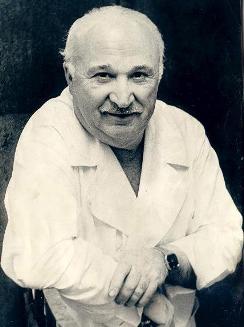
The founder · 1956–
Vakhtang Khutsidze, called “Tsope.”
The title of the clinic, and the nickname his friends gave the boy who wanted to be a sculptor.
Vakhtang, Galaktion's son, Khutsidze dreamed of becoming a painter, a sculptor, a carver. He had everything needed to make that dream real — a talent for painting that showed itself just as naturally in sculpture. But the patriotic war changed his path. The country needed people with a medical education, and so he became a doctor and surgeon: an otorhinolaryngologist.
The dream never left him. It lived on in his mind and found its way out through a surgeon's hands instead of a sculptor's chisel — the same sense of exquisiteness and beauty, the same habit of turning ordinary work into something closer to art.
“If Tsope was not a great master, how could he have operated on more than 50,000 women and men?”
It happened in 1956. Already an experienced otorhinolaryngologist, Vakhtang performed his first plastic surgery on a young artist who believed her nose stood in the way of her career. The risk was real — but so was the reward. The operation succeeded, and both surgeon and patient were changed by it: he had sculpted a face, successfully, for the first time.
That operation became his first step toward what colleagues would later call the Olympus of plastic surgery. The childhood nickname “Tsope” became a legendary name, respected across his field. Unlike most surgeons of his era, he refused surface cuts from that very first operation onward, establishing the endonasal method of aesthetic rhinoplasty — intranasal plastic surgery without visible incisions. The technique later earned wide recognition.
Vakhtang was never satisfied with what he had already achieved. He kept searching for methods of aesthetic rhinoplasty that would preserve a face's individuality and character rather than erase it. He would picture a patient's face after surgery before he ever picked up an instrument — and if true beauty called for more than a corrected nose, a chin as well, he would say so, always in partnership with the patient. Where Pygmalion could destroy his own work if it displeased him, “Tsope” worked with living people: their individuality, their worries, their hopes. That required a mastery beyond surgical skill alone.
His patients ranged from a young Moscow artist with exacting demands to a modest woman who had come from a Georgian village — each trusting him completely, each treated with the same care. A Ukrainian actress once came to him needing a straighter, more “Greek” profile for a role that her natural Slavic nose didn't suit; the operation succeeded, and Tsope's sense of humor about it cheered his friends for years afterward.
At the center of every operation was one idea: not simply sculpting individual features, but preserving the harmony of the whole face. It was, in his own words, the meeting point of surgeon and sculptor.
An international career
Dr. Vakhtang Khutsidze operated across the world, on many different facial structures and for patients of very different temperaments — and he was equally generous in sharing what he learned, studying the achievements of plastic surgery worldwide with genuine modesty.
- 1963 · Prague
Worked alongside the renowned clinic of Professor Burian.
- 1965 · Mexico City
Performed rhinoplasty together with plastic surgeon Alejandro Del Rio.
- 1967 · Japan
Demonstrated striking modifications of large “Caucasus” noses to Dr. Fumio Umezawa and colleagues, while adopting their experience with rib-graft techniques for low Asian nasal profiles.
- 1970 · Paris
Worked with the noted Parisian surgeon and friend Louis Vidal.
- 1985 · United States
Exchanged experience with Professor John Sinnell and Cornell-trained surgeons Randolph Harris and Robert Shureger, and brought facial and body liposuction technology back to the Tbilisi clinic.
- 1998 · Nuremberg
Shared his closed-rhinoplasty methods with Dr. Thomas Rymans and Professor Nietzsche, who adopted them enthusiastically into their own practice.
A true work of art always crosses borders. Dr. Vakhtang Khutsidze established a school of plastic surgery in Georgia and left behind many students and followers — among them his own son, Dr. Zurab Khutsidze, who inherited a painter's eye, a surgeon's steady hand, and the same devotion to the craft.